

 Weighing Scale
  Moisture Analyzers
 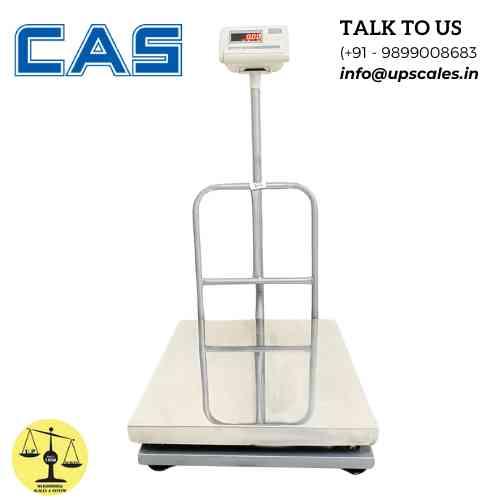 CAS Weighing Scale
  Aczet Weighing Machines
  Adam Equipment
  Sartorius
  Mettler Toledo
  Essae Weighing Scales





Weight vs. Mass: The Simple Explanation for Industrial Weighing
 By Manish Sharma 8 months ago
The Kitchen Scale vs. The Science Lab: Why Knowing "Weight vs. Mass" Actually Matters in Your Factory
Here’s a brain teaser: If you take a perfectly calibrated scale from your shipping dock, fly it to the top of a mountain, and weigh the same pallet, will it read the same?
The answer is no. It will read slightly less.
And if you could take that scale to the Moon? The pallet would weigh about one-sixth of its Earth weight. But here’s the kicker: the amount of stuff in that pallet—the metal, wood, and plastic—hasn't changed at all.
This is the classic, often misunderstood, difference between Weight and Mass. While people use the terms interchangeably in everyday talk, in the world of precise measurement, conflating them can lead to serious errors in science, trade, and even interplanetary logistics. Let's clear it up once and for all.
The One-Sentence Definition
- Mass is the amount of matter (stuff) in an object. It never changes, no matter where you are in the universe.
- Weight is the force of gravity pulling on that mass. It changes with location.
Your industrial scale doesn't measure mass directly. It measures weight force. Then, it uses the constant force of Earth's gravity at your location to calculate and display what we call mass (in kg or lbs). This is a critical detail.
Breaking It Down: A Simple Analogy
Think of mass as your body. Your bones, muscles, and organs.
Think of weight as the reading on a scale. That reading depends on two things: your body (mass) and the strength of gravity where you're standing.
Take your body to the Moon (less gravity), and the scale reads less. Your mass hasn't changed; the force pulling you down has.
Why Does This Matter on Earth? Gravity Isn't Constant?
This is where it gets practical for industrial users. While we don't ship goods to the Moon, Earth's gravity is not perfectly uniform everywhere.
- Altitude: Gravity is slightly weaker at the top of a mountain than at sea level.
- Latitude: Because the Earth spins and bulges at the equator, gravity is slightly stronger at the poles than at the equator.
These differences are tiny—about 0.5% from equator to pole—but for high-precision labs, pharmaceutical companies, or anyone requiring traceable measurements, they are significant.
The Scale's Secret: It Measures Force, then Calculates
Your scale's load cell is a force transducer. When you place an object on it, it measures the force (in Newtons) pushing down. To convert this force to a mass reading (kg), the scale's computer uses a fixed conversion factor based on standard gravity (9.80665 m/s²).
This is why calibration is location-specific. When a technician calibrates your scale with certified masses (often called "weights"), they are essentially programming the scale by saying, "In this specific spot on Earth, with the local gravity here, this known force equals this known mass."
If you move a high-precision scale to a new location with a different gravitational pull, it must be recalibrated to be accurate.
The Tool for Each Job: Balances vs. Scales
This distinction explains the different tools:
- A Balance compares an unknown mass to a known mass. It's inherently measuring mass and is unaffected by local gravity changes. Used in labs for extreme precision.
- A Scale measures the force of weight. It's affected by gravity. Used for 99.9% of industrial applications where the variation is negligible or accounted for in local calibration.
When "Weight vs. Mass" Becomes a Legal and Financial Issue
In legal-for-trade applications, what you're actually buying and selling is mass. You are transacting for a specific quantity of matter (e.g., a kilogram of coffee beans).
The government-approved scale, calibrated with certified masses, ensures that despite local gravity variations, the mass you receive is correct. The system is designed so that the force measurement, when properly calibrated, accurately represents the true mass, creating a fair transaction anywhere.
The Bottom Line for Your Business
For most industrial applications—weighing Cast Iron, counting parts, batching recipes—you can happily use the word "weight" to mean "mass." The system is designed for that.
But understanding the distinction is power. It explains:
- Why calibration is sacred: You're aligning your force meter to the local gravitational constant.
- Why you can't simply move a precision scale: It may need re-calibration.
- The science behind your tool: You're not just reading a number; you're interpreting a force measurement within a controlled system.
So the next time you look at your scale, remember: it's a local gravity interpreter, giving you the most important number—the amount of stuff—by measuring the pull of our entire planet.
Need precision that accounts for the science of measurement? Our Precision Balances and Scales are calibrated for the accuracy your application demands, whether it's in a lab or on a loading dock.
Categories
Trending Now